Wireless data is information transmitted through Wi-Fi, Bluetooth, cellular, and other radio-based networks that can help organizations understand how workspaces, equipment, and people are being used. Used responsibly, it can improve workplace operations by revealing occupancy patterns, supporting asset and equipment tracking, strengthening facilities management, and helping teams respond to changing conditions. The opportunity is significant: the U.S. Environmental Protection Agency estimates that commercial buildings account for about 18% of U.S. primary energy consumption, while the U.S. Department of Energy says commercial buildings waste roughly 30% of the energy they consume. Wireless sensors and operational analytics can help identify avoidable use, but successful programs require accurate measurement, cybersecurity, privacy safeguards, and clear limits on employee monitoring.
Wireless Data Improves Workplace Operations Through Measurement and Feedback
Wireless data for workplace operations is information gathered or transmitted using radio-frequency technologies and interpreted to support decisions about facilities, equipment, and work processes. The National Institute of Standards and Technology (NIST) describes the Internet of Things as a network of interacting devices that can connect, communicate, and exchange data. In a workplace, those devices may include occupancy sensors, connected thermostats, access-control systems, machine monitors, and employee-facing applications.
The core operational cycle is straightforward: collect a relevant signal, interpret it in context, and take an action. For example, room-occupancy readings can inform space planning, while temperature and equipment data can help facilities teams detect problems before they disrupt work. The value is not the volume of data collected; it is whether the information is reliable, proportionate, secure, and useful to a defined operational decision.
Operational visibility and data quality
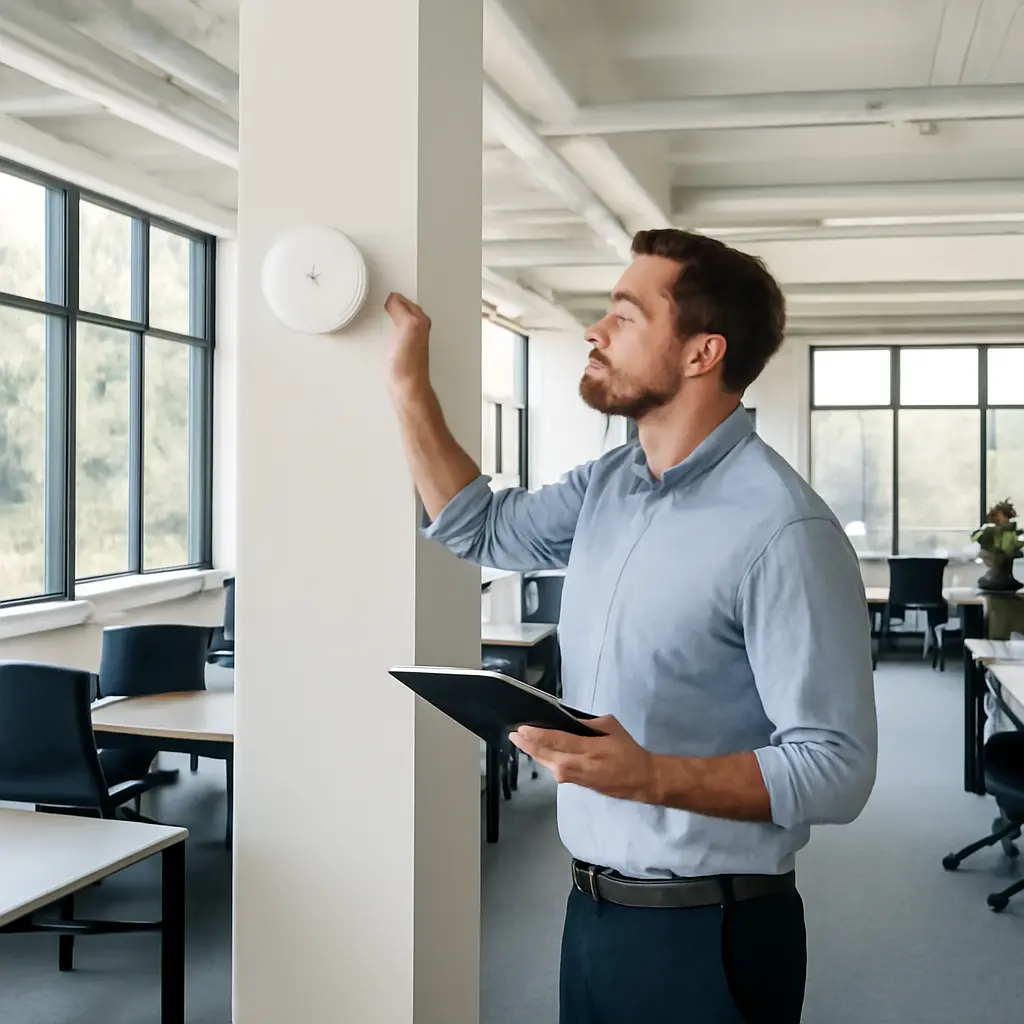
Operational visibility means having timely information about conditions that affect work, such as whether a meeting room is occupied, whether equipment is operating normally, or whether an area needs maintenance. Wireless systems can provide more frequent readings than manual inspections, but readings need context. A motion sensor, for instance, may register an empty room as occupied or fail to detect a stationary person. Organizations should validate sensor coverage, compare readings with ground truth, and document how missing or inaccurate data are handled.
The International Organization for Standardization’s ISO 50001 energy-management framework emphasizes measurement and continual improvement. That principle applies broadly: establish a baseline, define a target, measure consistently, and check whether operational changes produced the expected result. A chart comparing hourly occupancy with lighting or heating demand can help reveal mismatches, though it should be based on appropriately aggregated data.
From data collection to operational decisions
A wireless-data program should begin with a decision rather than a device. A facilities team might ask whether underused zones can be consolidated, whether HVAC schedules match actual building use, or whether a frequently failing asset needs preventive maintenance. This approach reduces unnecessary collection and makes success measurable through indicators such as energy use per occupied hour, equipment downtime, work-order response time, or space utilization.
This measurement foundation leads naturally to the most visible applications: managing space, energy, and building conditions. These applications can deliver operational benefits, but they depend on matching the technology to the building and to the decisions staff can actually make.
Wireless Data Optimizes Workplace Space and Building Systems
Space and building optimization uses wireless signals to align facilities resources with real conditions. Common technologies include Wi-Fi or Bluetooth-based presence estimates, dedicated occupancy sensors, smart meters, and connected building-management systems. Each has different accuracy, range, power, and privacy characteristics, so organizations should select systems according to the use case rather than assume one sensor can answer every question.
Occupancy and space utilization
Occupancy data estimates whether people are present in a room or zone; utilization analysis compares that presence with available capacity and scheduled use. Facilities teams can use aggregated counts to identify persistently underused areas, plan cleaning, or adjust room availability. The U.S. General Services Administration’s workplace research has documented the importance of measuring how federal workspaces are used, while also highlighting that utilization findings depend on the measurement method and period studied.
Wireless network data may indicate that a device is nearby, but it does not necessarily establish that a person is present or identify how many people share a space. Device ownership, signal strength, network settings, and privacy features can affect estimates. For more reliable counts, organizations can combine appropriately configured sensors with periodic manual validation and report results at the room or zone level rather than tracking named individuals.
Energy management and indoor conditions
Wireless temperature, humidity, light, and air-quality sensors can help building operators detect conditions that warrant adjustment. The U.S. Department of Energy reports that commercial buildings waste about 30% of the energy they consume, making better scheduling and control a potential source of savings. That figure describes a broad national estimate, not a guaranteed saving for any particular workplace; actual results depend on building systems, climate, operating schedules, and maintenance.
For example, occupancy-linked controls may reduce lighting or ventilation in areas that are not in use, while connected meters can flag unusual consumption for investigation. Operators must balance efficiency with comfort and health. The American Society of Heating, Refrigerating and Air-Conditioning Engineers (ASHRAE) publishes ventilation and indoor-environment standards; wireless readings should support qualified building professionals, not replace applicable codes, commissioning, or expert assessment.
Facilities maintenance and service response
Connected equipment can report operating hours, temperature, vibration, or fault conditions, helping maintenance teams prioritize inspections. Predictive maintenance uses condition data to estimate when intervention may be needed, whereas preventive maintenance follows a planned schedule. Wireless monitoring can support both approaches, especially where equipment is difficult to inspect continuously, but alerts require thresholds that limit false alarms and a workflow for assigning and closing work orders.
The U.S. Department of Energy’s Federal Energy Management Program recommends systematic operations and maintenance practices because poorly maintained building systems can waste energy and impair reliability. A wireless alert is therefore most useful when it connects to an accountable process: verify the condition, diagnose its cause, record the repair, and evaluate whether recurrence decreases.
Beyond buildings, wireless data can improve the flow of physical assets and materials. The same principles of fit-for-purpose measurement and accountable action apply to inventory, tools, and mobile equipment.
Wireless Data Strengthens Asset Tracking and Workflow Coordination
Asset tracking uses wireless technologies to estimate or record the location and status of items such as laptops, tools, medical equipment, vehicles, and inventory. Depending on the required range and precision, systems may use radio-frequency identification (RFID), Bluetooth Low Energy, Wi-Fi, ultra-wideband, or cellular connectivity. The appropriate technology depends on whether the goal is to identify an item at a doorway, locate it within a room, monitor it across a campus, or track it over long distances.
Inventory, tools, and equipment visibility
Wireless identification can reduce time spent searching for shared equipment and help teams reconcile inventory. RFID, for example, allows tagged items to be read without requiring each tag to be visually scanned, although performance depends on tag placement, reader configuration, materials, and the surrounding environment. A workplace should pilot the system with representative assets before relying on it for safety-critical or financial records.
A practical asset program links location signals to an inventory record, an owner or responsible team, and a defined response when an item is overdue or unavailable. Useful measures include time to locate equipment, loss rates, duplicate purchases, and asset availability. These operational measures are more meaningful than the number of tags installed.
Workflow coordination and service delivery
Wireless status updates can coordinate work across facilities, warehouses, laboratories, and service teams. A sensor may indicate that a shared space needs attention; a connected work-order system can then route the task and record completion. In logistics settings, location data can help teams identify bottlenecks or improve the handoff of materials. The system should make responsibilities clearer rather than simply add alerts to already overloaded staff.
Organizations can assess workflow improvements by comparing baseline and post-deployment performance, such as average response time, missed handoffs, or equipment idle time. Comparisons should account for changes in staffing, workload, and operating hours so that a technology deployment is not credited for effects caused by other factors.
Safety and emergency applications
Wireless systems can support safety by reporting environmental hazards, equipment status, or location information during an emergency. Examples include connected alarms, indoor wayfinding, and sensors that detect abnormal conditions. These systems should complement established safety procedures, tested alarms, and trained responders. No wireless network should be treated as the sole safeguard where a failure could put people at risk.
Because location and behavior signals can become sensitive, asset and workflow programs need governance as well as technical controls. The operational benefit depends on trust: employees and visitors should understand what is collected, why it is collected, and who can access it.
Wireless Data Requires Privacy, Security, and Responsible Governance
Workplace wireless data may reveal information about people even when a system was installed for facilities management. Device identifiers, access logs, location histories, and detailed occupancy records can become personal or sensitive data when they are linked to an individual. Responsible governance defines permitted purposes, limits collection, controls access, and sets retention periods before deployment.
Privacy and employee transparency
Privacy-by-design means considering privacy risks from the planning stage rather than trying to correct them after launch. The U.S. Federal Trade Commission advises organizations to collect only data needed for a legitimate purpose, protect it, and retain it only as long as necessary. In practice, employers should explain the system in plain language, distinguish facilities analytics from individual performance monitoring, and avoid collecting identifiable location histories when aggregate counts will answer the operational question.
The National Institute of Standards and Technology’s Privacy Framework provides a voluntary structure for identifying and managing privacy risk. Organizations should also consult applicable employment, privacy, labor, and data-protection laws, which vary by jurisdiction. Where appropriate, involve employees, worker representatives, privacy officers, and legal counsel before implementation.
Cybersecurity and connected-device risk
Every connected sensor or gateway can create a potential entry point into a network. NIST’s guidance for Internet of Things cybersecurity emphasizes capabilities such as device identification, secure configuration, data protection, controlled access to interfaces, software updates, and cybersecurity-state awareness. Procurement teams should verify that vendors support security updates, use strong authentication, encrypt data in transit and at rest where appropriate, and provide a clear end-of-support policy.
Security also depends on operational practices: segment building systems from general business networks where feasible, replace default credentials, monitor unusual activity, inventory devices, and remove access when equipment is retired. A wireless deployment should have an incident-response plan that covers vendor notification, service disruption, and potential exposure of personal or operational data.
Governance, retention, and access controls
A governance policy should identify the system owner, approved uses, data fields, retention schedule, access roles, and review process. Aggregation and de-identification can reduce risk, but they do not automatically make data anonymous; small groups, repeated observations, or combinations with other records may allow re-identification. Periodic audits can check whether actual use remains consistent with the stated purpose.
With these safeguards established, organizations can evaluate whether wireless data produces measurable results. A disciplined pilot is a practical way to test benefits, costs, user acceptance, and unintended consequences before scaling.
Wireless Data Programs Deliver Value Through Measured Implementation
A wireless-data implementation is a managed operational change, not simply a technology purchase. It should connect a business question to a suitable sensor, a responsible decision-maker, and an outcome measure. The U.S. Government Accountability Office’s work on federal building management underscores the importance of reliable information and performance measurement when agencies make decisions about facilities and resources.
Start with a bounded pilot
A pilot tests whether a system works in a limited setting before an organization makes a larger investment. Select a representative location, state the operational problem, record baseline conditions, and define success in advance. For instance, a pilot might test whether occupancy-informed HVAC scheduling lowers energy use without reducing comfort or whether equipment tags reduce search time for a particular team.
Include technical and human checks: sensor accuracy, network reliability, accessibility, employee understanding, maintenance effort, and the number of alerts that lead to useful action. A pilot should also specify how data will be deleted or retained if the program does not proceed.
Choose metrics that reflect outcomes
Outcome metrics show whether operations improved; activity metrics merely show that a system is being used. Relevant measures may include energy consumption per occupied hour, average equipment-retrieval time, work-order completion time, space utilization, or repeat equipment failures. Where possible, compare results with a similar location or a pre-deployment baseline, and report uncertainty and important limitations.
Organizations should avoid promising savings based solely on vendor projections or national averages. The EPA’s commercial-building energy information and the Department of Energy’s waste estimates explain why efficiency is worth investigating, but local measurement is needed to establish a workplace’s actual opportunity and realized results.
Build an operating model for scale
Scaling requires ownership across facilities, information technology, cybersecurity, privacy, procurement, and the teams using the information. Assign responsibility for device maintenance, data quality, alert response, vendor oversight, and periodic policy review. Plan for interoperability and replacement: a system that cannot export usable data or receive security updates may create long-term cost and risk.
A useful visual for decision-makers is a before-and-after dashboard that pairs operational outcomes with safeguards—for example, energy use and comfort complaints, or asset retrieval time and location-data retention. Presenting both benefits and constraints discourages the assumption that more collection always leads to better operations.
Conclusion: Use Wireless Data to Make Workplaces More Responsive
Wireless data can improve workplace operations by making space use, building performance, equipment status, and workflow conditions more visible. Occupancy and environmental sensing can inform facilities decisions; connected asset systems can reduce search and coordination friction; and device security, privacy governance, and measurement practices help ensure those gains are sustainable.
The broader implication is that workplace technology should serve people and operational goals, not collect data for its own sake. Begin with a specific problem, run a measured pilot, disclose the system’s purpose, minimize personal data, and evaluate results against a baseline. Facilities and operations leaders can further consult NIST’s IoT and Privacy Framework guidance, the Department of Energy’s building-efficiency resources, and relevant local privacy and workplace requirements before expanding a program.
Sources: National Institute of Standards and Technology, Internet of Things (IoT), https://www.nist.gov/internet-things-iot; U.S. Environmental Protection Agency, Energy Efficiency in Commercial Buildings, https://www.epa.gov/energy/energy-efficiency-commercial-buildings; U.S. Department of Energy, Re-tuning Buildings, https://www.energy.gov/eere/buildings/re-tuning-buildings; International Organization for Standardization, ISO 50001 Energy Management, https://www.iso.org/iso-50001-energy-management.html; U.S. General Services Administration, Workplace Utilization and Benchmarking, https://www.gsa.gov/real-estate/workplace-solutions/workplace-utilization-and-benchmarking; American Society of Heating, Refrigerating and Air-Conditioning Engineers, Standards and Guidelines, https://www.ashrae.org/technical-resources/standards-and-guidelines; U.S. Department of Energy, Operations and Maintenance Best Practices Guide, https://www.energy.gov/eere/femp/operations-and-maintenance-best-practices-guide; Federal Trade Commission, Protecting Personal Information: A Guide for Business, https://www.ftc.gov/business-guidance/resources/protecting-personal-information-guide-business; National Institute of Standards and Technology, NIST Privacy Framework, https://www.nist.gov/privacy-framework; National Institute of Standards and Technology, IoT Device Cybersecurity Capability Core Baseline, https://csrc.nist.gov/pubs/ir/8259/a/final; U.S. Government Accountability Office, Federal Buildings: Selected Agencies Should Improve Monitoring of their Real Property, https://www.gao.gov/products/gao-21-387