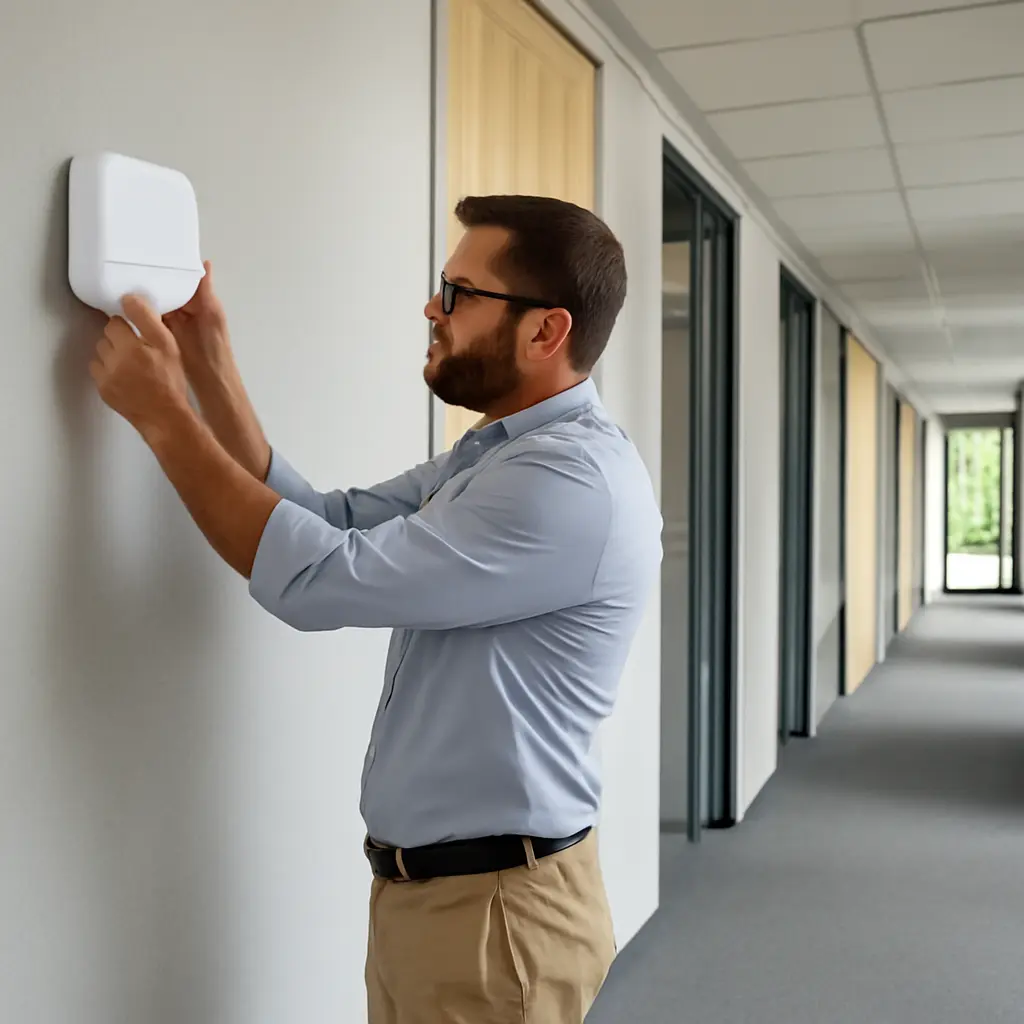
Consumer Wi-Fi and enterprise Wi-Fi both connect devices to wireless networks, but they differ in how they authenticate users, protect data, support large numbers of devices, and are managed. Consumer Wi-Fi typically relies on a shared password and equipment designed for a home; enterprise Wi-Fi commonly uses individual credentials, centralized administration, and security controls suited to organizations. The distinction matters as connected-device use grows: Cisco’s 2024 Annual Internet Report forecast that machine-to-machine connections would account for about half of global connected devices and connections by 2023, highlighting the management challenge posed by many devices. Understanding authentication, security, scale, and cost helps households and organizations choose an appropriate network.
Consumer and Enterprise Wi-Fi: Core Differences
Wi-Fi is a family of wireless networking technologies based on IEEE 802.11 standards. “Consumer” and “enterprise” describe common deployment models rather than separate kinds of radio waves: both can use the same Wi-Fi generations and frequency bands, while differing in equipment, configuration, security, and operational support.
The U.S. National Institute of Standards and Technology (NIST) describes wireless local area networks as networks that use radio communication to connect devices within a limited area. In practice, a home may be served by one router or mesh system, whereas a business may use multiple access points connected to centrally managed network infrastructure.
Consumer Wi-Fi definition and typical setup
Consumer Wi-Fi is a wireless network designed primarily for a household or small location. It commonly uses a broadband gateway or router, a network name (SSID), and a shared Wi-Fi password. Many consumer systems combine the modem, router, firewall, and wireless access point in one device, with setup and troubleshooting handled through an app or web interface.
Home networks may use WPA2-Personal or WPA3-Personal security. In Personal mode, devices generally prove they know the shared passphrase rather than presenting a separate identity for each user. This is convenient, but it means a household may need to change the password on every connected device if the password is shared too widely or must be replaced.
Enterprise Wi-Fi definition and typical setup
Enterprise Wi-Fi is a wireless deployment designed for an organization that needs to connect and manage many users, devices, or locations. It often includes multiple access points, centralized monitoring, identity-based authentication, network segmentation, and integration with an authentication service such as RADIUS. The Wi-Fi Alliance identifies WPA3-Enterprise as a security mode intended for enterprise networks, with configurable protections and authentication options.
Enterprise networks may also provide separate SSIDs or virtual network segments for employees, guests, and specialized equipment. Central management lets administrators apply consistent settings across access points and review network health, while individual credentials can be revoked without changing every other user’s access.
Authentication and Security in Consumer and Enterprise Wi-Fi
Authentication is the process of verifying a user or device before granting network access. It is a key dividing line between the two deployment models: consumer networks commonly authenticate possession of a shared passphrase, while enterprise networks can authenticate each user or device separately. Neither label guarantees safety on its own; secure configuration, software updates, and sound operating practices remain essential.
Shared passwords and Personal mode
WPA2-Personal and WPA3-Personal use a pre-shared key or passphrase. This approach is practical for homes and small settings because it requires little infrastructure. Its trade-off is that users often share one credential, making it harder to know who connected and more disruptive to remove access when a guest or former household member no longer needs it.
WPA3, introduced by the Wi-Fi Alliance in 2018, strengthened Wi-Fi security and introduced Simultaneous Authentication of Equals (SAE) for Personal networks. The Alliance says SAE is designed to provide stronger protection against password-guessing attacks than the legacy WPA2-Personal exchange. A strong, unique passphrase and current router firmware are still important.
Individual credentials and Enterprise mode
WPA2-Enterprise and WPA3-Enterprise use 802.1X authentication, commonly with an authentication server such as RADIUS. Instead of relying solely on one shared network password, the system can verify individual credentials or certificates. An organization can disable one account or device without resetting the credentials used by everyone else.
NIST Special Publication 800-97 discusses security considerations for IEEE 802.11 wireless networks, including authentication and encryption. Enterprise authentication can improve accountability and access control, but it takes more planning: administrators must configure identity systems, certificates or credentials, and compatible client devices correctly.
Guest access, segmentation, and device isolation
Network segmentation separates traffic into distinct logical networks. A home router may offer a guest network that limits visitors’ access to household devices. Enterprises typically use more granular controls to separate staff, visitors, point-of-sale equipment, cameras, and other device groups according to their security and operational needs.
Segmentation is particularly useful when devices have different risk profiles. For example, a guest’s phone generally should not be able to reach an organization’s internal file servers, and an internet-connected camera may not need access to employee laptops. Segmentation does not replace encryption or patching, but it can limit the consequences of a compromised device.
Coverage, Capacity, and Network Management
The right Wi-Fi design depends on more than the number of users. Building materials, interference, application demands, access-point placement, and the number and type of connected devices all affect performance. Consumer equipment emphasizes straightforward coverage; enterprise deployments add planning and monitoring tools to coordinate service across larger or busier spaces.
Coverage and access-point design
A consumer router may be sufficient for a small home, while a larger or multi-storey home may benefit from mesh nodes or additional access points. Enterprise environments commonly use multiple access points placed to provide overlapping coverage and accommodate user density. A warehouse, school, hotel, and office can each require different placement because walls, shelving, client mobility, and traffic patterns vary.
Wireless standards also evolve. Wi-Fi 6, based on IEEE 802.11ax, introduced features intended to improve efficiency in dense environments, including Orthogonal Frequency-Division Multiple Access (OFDMA). The Wi-Fi Alliance’s Wi-Fi CERTIFIED 6 program launched in 2019. A newer standard can help, but actual results depend on compatible client devices, network design, and interference conditions.
Capacity and connected-device growth
Capacity is a network’s ability to serve multiple devices and applications reliably, not simply its advertised maximum speed. Video calls, cloud applications, streaming, and large file transfers compete for airtime. Cisco’s 2024 Annual Internet Report forecast that global connected devices and connections would reach 29.3 billion by 2023, with machine-to-machine connections making up 50 percent of the total. This forecast illustrates why organizations must account for devices beyond employee phones and computers.
A home may have dozens of connected devices, including televisions, speakers, appliances, and sensors. A business may have many more, with additional requirements for roaming, voice, point-of-sale transactions, or operational technology. Enterprise planning typically considers device density and application priorities; consumer networks may offer simpler quality-of-service settings, but often provide less detailed control.
Centralized monitoring and troubleshooting
Consumer systems are generally managed through a router interface or mobile app, with basic tools such as device lists, parental controls, and guest-network settings. Enterprise management platforms can configure many access points at once, track performance, identify outages, and support consistent policies across buildings or sites.
Centralized management is valuable when an organization cannot practically inspect each access point manually. However, it introduces administrative responsibilities, including protecting management accounts, maintaining software, and reviewing alerts. A managed service provider may perform some of these tasks for smaller organizations.
Cost, Support, and Choosing the Right Wi-Fi
Consumer Wi-Fi usually costs less and is easier to set up, while enterprise Wi-Fi may require higher equipment, licensing, installation, and staffing costs. The more appropriate comparison is total cost against required security, availability, coverage, and support—not purchase price alone.
Equipment and ongoing operating costs
A consumer router or mesh kit is generally purchased as a packaged product, with management features included or bundled into an app. Enterprise deployments may involve business-grade access points, controllers or cloud-management subscriptions, structured cabling, site surveys, and technical support. Costs vary considerably by vendor, building, number of access points, and service requirements, so no single price comparison applies universally.
Organizations should also account for staff time, firmware and security updates, replacement cycles, and the cost of outages. A small office may find a well-configured business-grade or prosumer system sufficient; a hospital, campus, or multi-site company may need enterprise capabilities because downtime and access-control failures carry greater consequences.
Support, reliability, and accountability
Consumer products commonly rely on self-service support, retailer assistance, or the internet service provider. Enterprise products may include vendor support agreements, centralized alerting, and service-level commitments. Such arrangements can help with recovery and diagnosis, but they do not guarantee uninterrupted service; organizations still need backups, documented procedures, and tested incident response.
For regulated or sensitive environments, Wi-Fi must also fit broader security and privacy obligations. The network design should be reviewed alongside identity management, endpoint security, logging, and applicable legal requirements. Enterprise equipment alone does not make a network compliant or secure.
Practical selection checklist
- Choose consumer Wi-Fi for a typical household when simple setup, adequate coverage, and shared-password access meet the need.
- Consider business or enterprise Wi-Fi when individual user authentication, multiple locations, centralized administration, guest controls, or detailed segmentation are important.
- Estimate the number and type of devices, the busiest areas, and the applications that require reliable service.
- Check support for current security standards, automatic or timely firmware updates, and a separate guest network.
- For a business, document who administers the network, how access is removed, and how outages or security incidents are handled.
Conclusion: Consumer and Enterprise Wi-Fi in Context
Consumer Wi-Fi prioritizes convenient setup and affordable household connectivity; enterprise Wi-Fi adds identity-based authentication, segmentation, centralized management, and capacity planning for organizational demands. The underlying Wi-Fi standards can overlap, but the deployment model determines how access is controlled, how problems are managed, and how well the network scales. As connected devices proliferate, selecting a network based on actual coverage, security, and support needs is increasingly important. Review your device count and risk requirements, update existing equipment, and consult a qualified network professional when an organization needs individualized access controls or reliable multi-site service.
Sources: National Institute of Standards and Technology, Guidelines for Securing Wireless Local Area Networks (WLANs), https://csrc.nist.gov/pubs/sp/800/153/final; National Institute of Standards and Technology, Establishing Wireless Robust Security Networks: A Guide to IEEE 802.11i, https://csrc.nist.gov/pubs/sp/800/97/final; Wi-Fi Alliance, WPA3 Security, https://www.wi-fi.org/discover-wi-fi/security; Wi-Fi Alliance, Wi-Fi CERTIFIED 6, https://www.wi-fi.org/discover-wi-fi/wi-fi-certified-6; Cisco, Cisco Annual Internet Report (2018–2023), https://www.cisco.com/c/en/us/solutions/collateral/executive-perspectives/annual-internet-report/white-paper-c11-741490.html