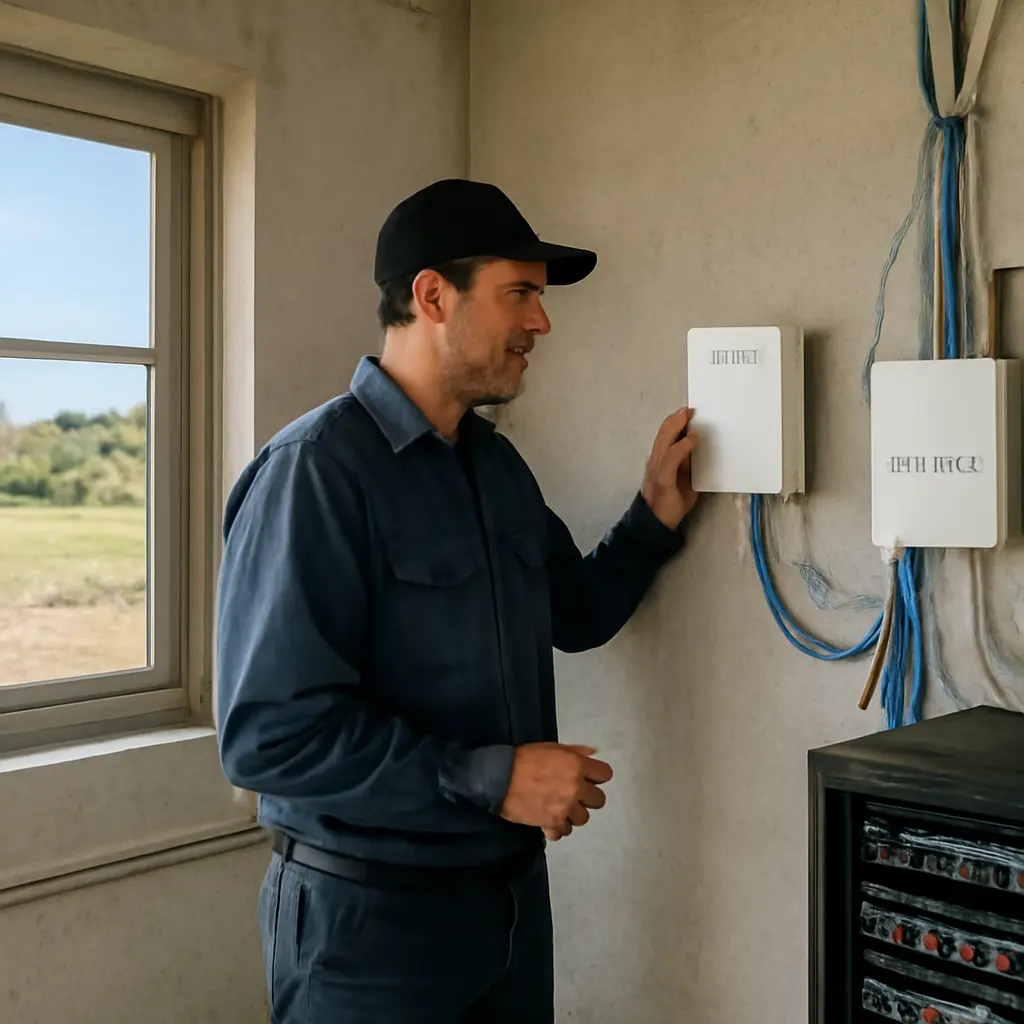
A cellular modem and a fiber gateway are customer-premises devices that connect a remote site to a wide-area network, but they use different access networks: cellular modems use a mobile operator’s radio network, while fiber gateways use a physical optical-fiber connection. For remote locations, cellular is often faster to deploy and useful as a primary or backup connection; fiber generally offers more predictable capacity, lower latency, and stronger suitability for sustained, bandwidth-intensive traffic where service is available. The choice depends on coverage, service-level requirements, total cost, installation time, and resilience—not headline speed alone. The FCC’s broadband benchmark is 100 Mbps download and 20 Mbps upload, but actual performance at a site depends on the access technology, local conditions, and the service plan.
Remote-site connectivity and the cellular modem–fiber gateway comparison
A cellular modem converts data between a site’s local network and a cellular carrier’s radio network. A fiber gateway connects the local network to an optical-fiber service and commonly combines an optical network terminal (ONT) with routing and Wi-Fi functions. In practice, “gateway” may refer to a single integrated device or to separate ONT and router hardware.
These options matter to organizations operating branch offices, construction sites, utility facilities, farms, retail locations, and temporary workspaces. Fiber can offer high capacity and consistent performance, but extending it to an unserved site may involve construction, permits, and a long lead time. Cellular can be installed quickly, yet coverage, congestion, signal quality, data allowances, and carrier policies can limit performance. A sensible evaluation therefore compares availability and measured service at the actual site, alongside cost, security, and continuity needs.
Access technology defines cellular modem and fiber gateway performance
The U.S. Federal Communications Commission (FCC) defines fixed broadband benchmarks in terms of minimum download and upload speeds; its current benchmark is 100 Mbps download and 20 Mbps upload. That benchmark is a reference for evaluating broadband, not a guarantee that every cellular or fiber service will deliver those speeds at every moment. A remote-site comparison should also include latency, jitter, packet loss, uptime, data limits, and upload capacity.
Cellular modems: 4G LTE, 5G, and fixed wireless access
A cellular modem transmits and receives data over a mobile network, typically using 4G LTE or 5G. It may be built into a router, installed as a USB or embedded module, or provided as an outdoor unit connected to an indoor gateway. Fixed wireless access (FWA) is a service model that uses cellular radio links to provide broadband to a fixed location; it is not a separate physical medium from cellular.
Cellular performance depends on factors such as distance from a cell site, frequency band, building materials, antenna placement, terrain, network load, and the operator’s available spectrum. The FCC’s National Broadband Map shows reported availability, but a map result cannot establish the signal quality or busy-hour speed inside a particular building. For business-critical deployments, test the intended carrier at the installation location, ideally at different times of day, and consider an external directional or multi-antenna unit where appropriate.
Fiber gateways: FTTH, dedicated fiber, and shared access
A fiber gateway serves a premises connected by optical fiber, often through fiber-to-the-home or fiber-to-the-building (FTTH/FTTB). The ONT converts optical signals into an Ethernet interface for the customer’s router or gateway. Fiber-to-the-premises can deliver symmetrical service plans, but symmetry, contention, uptime, and repair commitments vary by provider and product.
Shared passive optical networks, such as GPON and XGS-PON, share portions of network capacity among subscribers; dedicated business fiber may provide different capacity and service guarantees. The physical presence of fiber does not by itself mean a site has a dedicated circuit or a particular service-level agreement. Buyers should confirm the quoted bandwidth, upload rate, contention terms, public addressing, repair targets, and any construction charges in the provider’s contract.
Reliability and deployment trade-offs for remote sites
Once the access method is understood, the operational question is how consistently it will support the site’s applications. A connection that meets a speed test once may still be unsuitable if it degrades during peak hours, has restrictive data policies, or takes too long to repair after an outage.
Latency, throughput, and busy-hour behavior
Throughput is the volume of data delivered over time; latency is the time taken for data to travel between endpoints. Fiber usually provides low, stable latency because its path is a wired optical connection, while cellular latency can vary with radio conditions, scheduling, and network congestion. These are general tendencies, not guarantees: routing, backhaul, service design, and the remote application also affect results.
For video meetings, cloud desktops, voice, point-of-sale systems, and remote control, measure latency, jitter, and packet loss as well as download and upload speeds. For camera backups, large file transfers, and cloud replication, upload capacity and monthly data allowances may be more consequential than peak download speed. A useful comparison records repeated tests during expected busy hours and checks performance against the application’s actual requirements.
Availability, installation time, and restoration
Cellular service can often be activated without trenching a new access line, making it attractive for temporary sites, rapid openings, and locations where wired service is absent. Installation may still require carrier approval, suitable signal, equipment mounting, power, and secure placement. Fiber installation can be straightforward where a live connection already reaches the premises, but new construction may require engineering, rights-of-way, and provider work.
Restoration expectations should be verified rather than assumed. A consumer-grade fiber plan may not include the same repair commitment as a managed business circuit, and cellular service can be affected by local power failures, tower outages, or carrier congestion. Ask providers about service-level agreements, support hours, outage notification, repair targets, and whether a backup path is included.
Security, addressing, and remote management
Both technologies can support secure business networks, but security depends on configuration and management as well as the access link. Use current firmware, strong administrative credentials, encrypted remote-management methods, network segmentation, and a firewall policy appropriate to the site. Cellular connectivity should not be treated as inherently secure simply because it uses a carrier network.
Confirm whether the service provides a public or private IP address, static addressing, inbound connectivity, VPN compatibility, and any carrier-grade NAT restrictions. These details can affect security cameras, site-to-site VPNs, remote access, and hosted services. Where a provider uses carrier-grade NAT, outbound VPN or cloud-managed access may be more practical than attempting direct inbound connections.
Cost and site-fit determine the better connection
The best option is the one that meets the site’s operational requirements at an acceptable lifecycle cost. Compare more than the monthly access fee: include equipment, installation, construction, data overages, support, backup service, and the business cost of downtime.
When a cellular modem is a strong fit
Cellular is often a good fit when a site needs service quickly, has no practical wired option, uses moderate data, or needs an independent backup path. Examples include pop-up retail, construction trailers, kiosks, mobile or seasonal operations, and branch locations awaiting fiber construction. It can also provide rapid failover when a primary wired service fails, provided the router and carrier plan support automatic switching.
Before deployment, verify indoor and outdoor signal, test candidate carriers, review data caps and throttling rules, and check whether the plan permits business or fixed-site use. For a site with substantial video uploads or many users, validate real-world upload throughput and peak-period performance rather than relying on advertised maximum speeds.
When a fiber gateway is a strong fit
Fiber is generally preferable when it is available at a reasonable installation cost and the site needs sustained high bandwidth, strong upload capacity, predictable performance, or support for many concurrent users. It is a natural primary connection for offices, distribution facilities, clinics, and other locations that rely heavily on cloud applications, voice, video, or large data transfers.
A fiber quote should distinguish standard internet access from dedicated business connectivity. Compare symmetrical speeds, contention, static IP options, outage response, contract terms, and one-time construction costs. If a fiber build is expensive or slow, a cellular service can bridge the gap while the wired connection is installed.
Hybrid connectivity: fiber primary with cellular backup
A hybrid design uses two access paths, commonly fiber as the primary connection and cellular as backup. A dual-WAN router can fail over automatically when the primary path becomes unavailable; some systems can also distribute traffic across links. True resilience requires attention to common failure points: backup power, separate carrier infrastructure, antenna placement, router configuration, and periodic failover tests.
For example, a rural retail site might use fiber for everyday point-of-sale, cloud, and guest traffic, with a cellular modem reserved for outages. A temporary construction office might begin on cellular and later move to fiber while retaining cellular backup. These designs illustrate why the comparison is not always either-or: the technologies can complement each other.
A practical evaluation checklist for remote-site connectivity
Use the following process to compare available services on equivalent terms:
- List application needs, user count, expected upload and download volumes, and the consequences of an outage.
- Check wired availability and obtain written fiber pricing, including construction, equipment, and service-level terms.
- Test cellular coverage at the exact site with candidate carriers, including busy-hour measurements and the intended antenna location.
- Compare recurring charges, data policies, installation time, IP-address requirements, support, and restoration commitments.
- Decide whether the site requires one connection or a primary-and-backup design, then test failover and recovery.
- Reassess performance after deployment and periodically review usage, outages, and contract suitability.
A simple comparison chart can help stakeholders: list each candidate service against capacity, upload performance, latency, availability, installation lead time, monthly and one-time cost, data limits, and recovery commitments. The chart should use measured site results and provider terms rather than advertised peak speeds alone.
Conclusion: match cellular modems and fiber gateways to site requirements
Cellular modems provide flexible access over 4G LTE or 5G and can be deployed quickly, while fiber gateways connect sites to optical services that commonly offer more consistent capacity and strong upload potential. Neither label guarantees a particular experience: coverage, congestion, service design, data policies, equipment, and provider commitments all matter.
For a remote site, measure cellular service where it will be used, confirm the precise fiber offer and installation costs, and evaluate latency, upload needs, uptime, security, and total cost. Where downtime is costly, consider a tested hybrid design. Consult the FCC broadband map and provider documentation, then validate the final choice with site-specific tests before committing.
Sources: Federal Communications Commission, “FCC Increases Broadband Speed Benchmark,” https://www.fcc.gov/document/fcc-increases-broadband-speed-benchmark; Federal Communications Commission, “National Broadband Map,” https://broadbandmap.fcc.gov/; Federal Communications Commission, “Measuring Broadband America,” https://www.fcc.gov/general/measuring-broadband-america; National Institute of Standards and Technology, “Guidelines for Securing Wireless Local Area Networks (WLANs),” https://csrc.nist.gov/pubs/sp/800/153/final; Federal Communications Commission, “2024 Communications Marketplace Report,” https://www.fcc.gov/reports-research/reports/communications-marketplace-reports