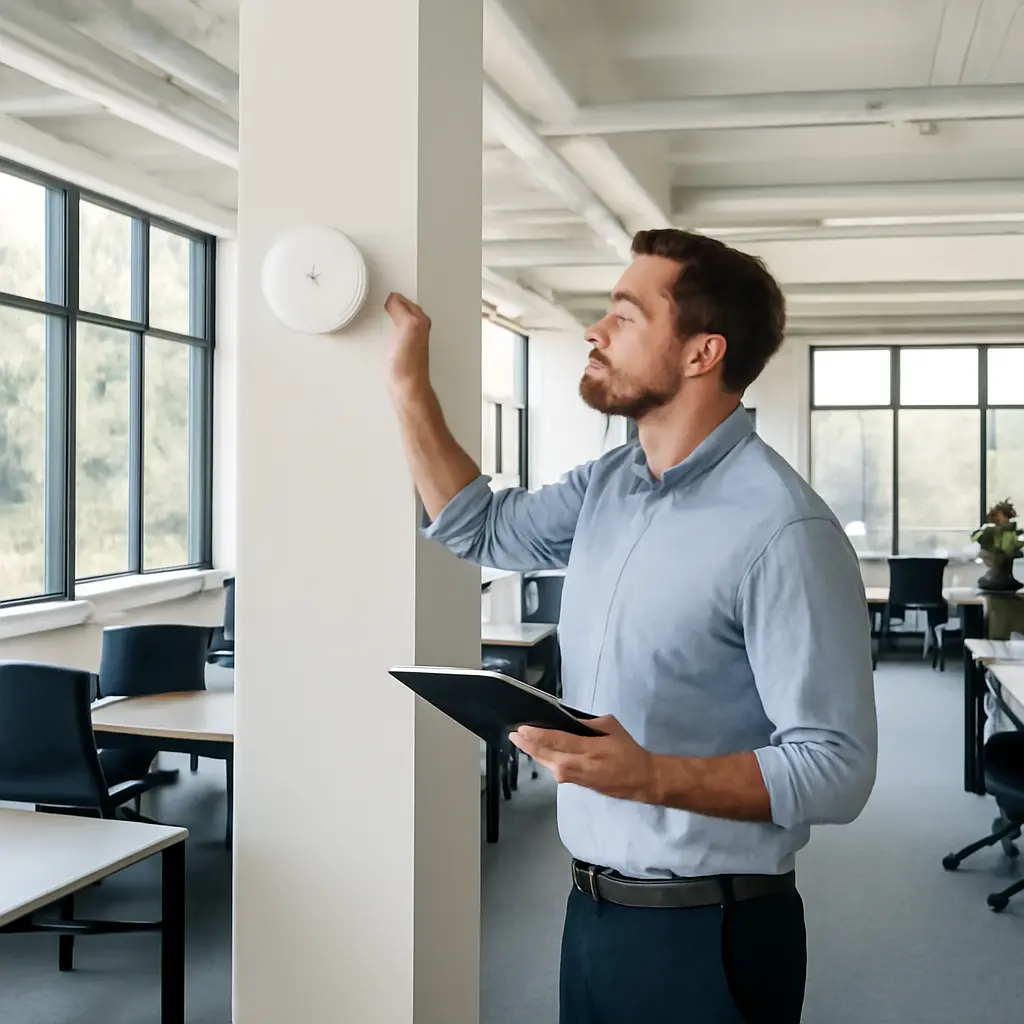
Industrial IoT hardware is the combination of connected sensors, controllers, gateways, and communications equipment designed to monitor or control industrial operations. Hardware that survives the shop floor is not simply “rugged”: it is selected and installed for the site’s actual temperature, vibration, moisture, dust, electrical noise, and maintenance conditions. That matters as factories connect more equipment—yet the International Society of Automation’s ISA/IEC 62443 standards emphasize that industrial security must be considered across the automation system, not treated as an afterthought. A dependable deployment therefore starts with environmental ratings, continues through power and network design, and is completed by cybersecurity, lifecycle planning, and field validation.
Industrial IoT Hardware Ruggedness: what the attribute means in a shop
Ruggedness is a product’s demonstrated ability to operate within specified environmental and electrical limits—not a universal certification or a synonym for a tough-looking enclosure. The International Electrotechnical Commission’s IEC 60529 defines the IP Code, which classifies the protection provided by an enclosure against access, solid objects, and water. The IEC’s IEC 60068 series, meanwhile, describes environmental tests such as vibration, shock, and temperature exposure. These standards define test conditions and classifications; they do not guarantee suitability for every factory or every installation.
The useful categories of shop-floor hardware include industrial sensors, programmable logic controllers (PLCs), remote I/O, industrial gateways, Ethernet switches, wireless access points, and edge computers. A device can be robust in one respect and vulnerable in another: an IP-rated enclosure may resist dust and water but still be unsuitable for corrosive chemicals, sustained vibration, electrical surges, or a temperature outside its specified operating range. Buyers should match the device’s published ratings to site conditions and verify that the rating applies to the assembled product, including connectors and cable entries.
Ingress protection: interpreting IP ratings
An IP rating communicates tested enclosure protection under IEC 60529. Its first digit concerns access to hazardous parts and protection against solid objects; its second digit concerns water protection. For example, IP67 indicates dust-tight protection and a defined temporary-immersion test. It does not mean the device is suitable for every washdown procedure, hot-water spray, chemical cleaner, or long-term underwater use. Those applications require checking the precise test conditions and manufacturer instructions.
In a packaging area with airborne dust, a sealed sensor may be appropriate; on a food-processing line, the same sensor may not withstand the chemicals, temperature, or cleaning pressure used for sanitation. The National Electrical Manufacturers Association’s enclosure types offer another classification system in North America. NEMA and IP ratings are not directly interchangeable, so procurement documents should specify the required standard rather than treating the labels as equivalent.
Temperature, vibration, and shock
Thermal, vibration, and shock tolerance describe separate operating limits. IEC 60068 includes test methods for environmental stresses, but a datasheet’s stated operating-temperature range is the key first check for the intended location. An enclosure mounted beside a furnace, on a vibrating press, or inside a sealed cabinet may experience conditions different from the ambient room temperature. Heat from nearby drives and power supplies can also raise cabinet temperature.
For rotating machinery, vibration can loosen terminals, fatigue cable assemblies, and disrupt connectors even when an electronic module continues functioning. Ask manufacturers for the applicable test method, frequency range, acceleration, duration, and mounting configuration; “vibration resistant” without these details is difficult to compare. Where possible, mount sensitive compute hardware away from the strongest vibration and use the specified strain relief and fasteners.
Industrial IoT Hardware Power and connectivity: design for electrical reality
Reliable hardware depends on power and communications that remain stable amid motor starts, switching loads, long cable runs, and maintenance changes. The National Institute of Standards and Technology’s Special Publication 800-82 Revision 3 describes operational technology (OT) as systems that interact with the physical environment, including industrial control systems. That distinction matters: a network interruption or compromised controller can affect production and safety, not just data availability.
A resilient architecture often separates deterministic control from higher-level data collection. Sensors and PLCs handle process signals; gateways or edge computers aggregate data and connect to supervisory systems or cloud platforms. The boundary between these layers should be deliberate, documented, and protected rather than created by plugging every device into the same flat network.
Power conditioning, grounding, and surge protection
Industrial power quality describes how closely supplied voltage and frequency match equipment requirements and how disturbances affect operation. Select power supplies for the available input, load, temperature, and required hold-up behavior. Use appropriate overcurrent protection, grounding, and surge protection based on the electrical design and applicable codes. Separate noisy loads from sensitive control electronics where practical, and follow the equipment manufacturer’s grounding and shielding instructions.
A common field failure is not a failed sensor but an intermittent supply, poor termination, or ground-potential difference. Commissioning should therefore include checking voltage at the device under load, inspecting terminal torque, confirming protective-earth continuity, and reviewing event logs for brownouts or resets. Record the results so later faults can be compared with a known baseline.
Wired Ethernet, industrial protocols, and wireless links
Industrial connectivity includes Ethernet, serial links, fieldbus networks, and wireless technologies such as Wi-Fi or private cellular. Protocols such as PROFINET, EtherNet/IP, Modbus TCP, and OPC UA serve different control, integration, and information-exchange needs. Protocol compatibility alone does not establish reliable performance: cable category, connector type, topology, latency, electromagnetic interference, and network load also matter.
Where a control loop requires predictable timing, a wired, engineered network is generally easier to validate than a shared wireless link. Wireless can be valuable for mobile assets or locations where cabling is impractical, but it requires a site survey, interference assessment, roaming tests, and a plan for coverage loss. The U.S. National Institute of Standards and Technology recommends risk-based OT security and architecture; its guidance supports treating network segmentation and controlled interfaces as part of system design.
Industrial IoT Hardware Cybersecurity and lifecycle: protect the device after installation
Industrial IoT cybersecurity is the set of safeguards that preserve the confidentiality, integrity, and availability of connected industrial assets while accounting for operational safety and uptime. NIST SP 800-82 Rev. 3 explains that OT security must account for performance, reliability, and safety requirements that differ from ordinary enterprise IT. The ISA/IEC 62443 series provides a risk-based framework for securing industrial automation and control systems across asset owners, integrators, and product suppliers.
Security also affects hardware selection. A device that cannot receive supported updates, use unique credentials, or provide useful logs can become a long-term liability. CISA’s guidance on industrial control systems stresses reducing exposure and limiting access; practical measures include isolating OT from business networks, removing unnecessary services, controlling remote access, and maintaining an inventory of connected assets.
Secure boot, updates, credentials, and remote access
Secure boot verifies software during startup; signed updates help ensure firmware comes from an authorized source; unique credentials reduce the risk created by shared defaults. These features should be assessed alongside the supplier’s vulnerability-disclosure process, update history, and stated support period. The U.S. Cybersecurity and Infrastructure Security Agency advises organizations to eliminate default passwords and avoid exposing industrial control devices directly to the public internet.
Remote maintenance should use a controlled access path, strong authentication, time-limited authorization, and recorded sessions where appropriate. If a gateway or edge computer is used to bridge networks, treat it as a security boundary: restrict inbound and outbound traffic, disable unused ports and services, and test recovery procedures before deployment.
Lifecycle support, spare parts, and maintainability
Lifecycle support is the period during which a supplier provides product availability, security fixes, firmware updates, documentation, and repair or replacement options. Industrial assets may remain installed for many years, so compare the expected service life with the vendor’s published support commitments. Confirm whether replacement units are pin-compatible, whether configuration backups are portable, and whether firmware versions can be recovered after a hardware swap.
Maintainability is a ruggedness attribute in practice: accessible connectors, clear status indicators, replaceable modules, and diagnostic logs can shorten downtime. Keep a documented asset register with model, serial number, firmware version, location, network identity, and critical spares. A spare that is untested or carries incompatible firmware is not a dependable recovery plan.
Industrial IoT Hardware Validation: prove it in the actual environment
Validation is the process of confirming that selected hardware performs its intended job under representative site conditions. Datasheet review is necessary, but a pilot installation can expose heat buildup, radio dead zones, connector strain, noisy power, or maintenance-access problems that a laboratory rating cannot reveal. The ISA/IEC 62443 approach likewise encourages risk assessment and security requirements tailored to the system and its operating context.
A practical qualification checklist
Before deployment, document the operating environment and acceptance criteria. Include normal and worst-case temperatures, dust or water exposure, vibration, chemical contact, power variation, network load, required uptime, and the consequences of a device failure. Test the complete assembly—including enclosure, glands, connectors, antenna, and mounting—not just the bare module.
- Verify IP or NEMA enclosure requirements against the actual cleaning and exposure conditions.
- Check operating-temperature, humidity, vibration, and shock specifications against measured site conditions.
- Confirm input voltage, grounding, surge protection, and behavior during power interruption.
- Test protocol interoperability, network segmentation, latency, and wireless coverage where applicable.
- Review secure update capability, authentication, logging, vulnerability response, and support lifetime.
- Record baseline performance and define inspection intervals, spares, and recovery steps.
Field example: monitoring a motor without disrupting control
Consider a plant adding vibration monitoring to an existing motor. A practical design uses a sensor rated for the installation environment, mounts it according to the manufacturer’s instructions, and sends measurements through a gateway that does not interfere with the motor’s PLC control path. During a pilot, technicians can compare sensor readings with established maintenance measurements, observe performance through startup and steady operation, and check that network loss does not alter machine control. The example illustrates an important principle: IIoT monitoring should add visibility without creating an untested dependency in a critical control loop.
For visual planning, a comparison chart can map each candidate device against IP or NEMA rating, operating temperature, vibration test, power input, protocol support, security-update period, and replacement lead time. A second diagram can show the sensor-to-gateway-to-control or analytics path, highlighting trust boundaries and any connection between OT and enterprise networks.
Conclusion: choose industrial IoT hardware by evidence, not appearance
Industrial IoT hardware survives the shop when its enclosure, temperature and vibration limits, power design, connectivity, cybersecurity, and lifecycle support match the real installation. IEC enclosure and environmental standards help define measurable tests; NIST and ISA/IEC guidance help frame OT security; and a site pilot confirms whether the whole system works in practice. Before buying, document conditions, compare published evidence, test the assembled design, and plan updates, spares, and recovery. Treat the hardware as part of an operational system—not as a standalone gadget—and the deployment is more likely to deliver useful data without adding avoidable downtime or risk.
Sources: International Electrotechnical Commission, IEC 60529 Degrees of protection provided by enclosures (IP Code), https://www.iec.ch/ip-ratings; International Electrotechnical Commission, IEC 60068 Environmental testing, https://www.iec.ch/standards; National Electrical Manufacturers Association, NEMA Enclosure Types, https://www.nema.org/standards/view/enclosures-for-electrical-equipment; National Institute of Standards and Technology, Guide to Operational Technology (OT) Security, SP 800-82 Rev. 3, https://csrc.nist.gov/pubs/sp/800/82/r3/final; International Society of Automation, ISA/IEC 62443 Series of Standards, https://www.isa.org/standards-and-publications/isa-standards/isa-iec-62443-series-of-standards; Cybersecurity and Infrastructure Security Agency, Industrial Control Systems Recommended Practices, https://www.cisa.gov/topics/industrial-control-systems